THE DECODE: THE ENTIRE ORIGINAL GAME, REVERSE-ENGINEERED IN ONE DAY
As part of building the remaster, we pointed Anthropic's brand-new Fable 5 AI model at the original 1990 executable — MIDWINTR.EXE — and asked it to reverse-engineer the codebase. In one overnight run it mapped and documented all 602 reachable functions, reconstructed the behavior of the major systems — terrain generation, enemy AI, vehicle physics, the win/lose logic, the file formats, the sound system — and we reimplemented the key algorithms to verify them. Work that had taken six months of piecemeal effort with earlier AI models, finished while we slept.
To be precise about what this is: comprehensive reverse-engineering and behavioral reconstruction, plus working algorithm replicas and asset extraction — not a clean recompilable decompile. For a remaster into a new engine you reimplement behavior rather than recompile old source, so the verified behavioral specs are the useful artifact. Everything is open for you to check.
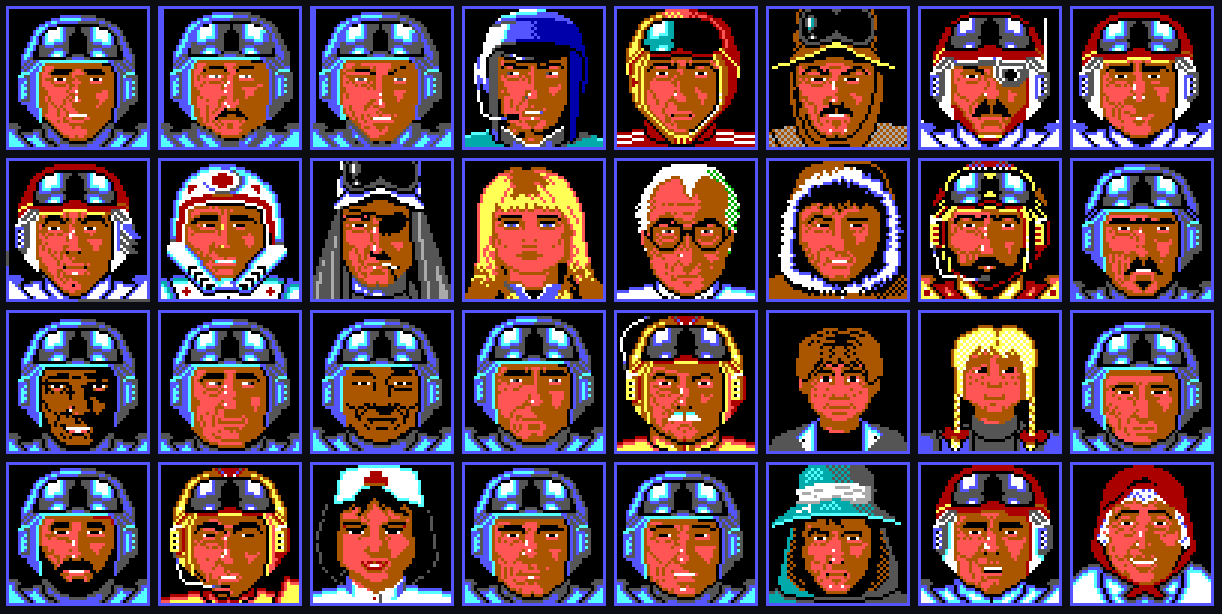
EFACES.CMP by reverse-engineering the sprite codec (a nibble-RLE
decompressor) out of the disassembly, in the original EGA 16-colour palette.
Real assets pulled straight from the binary.WHAT WAS RECOVERED
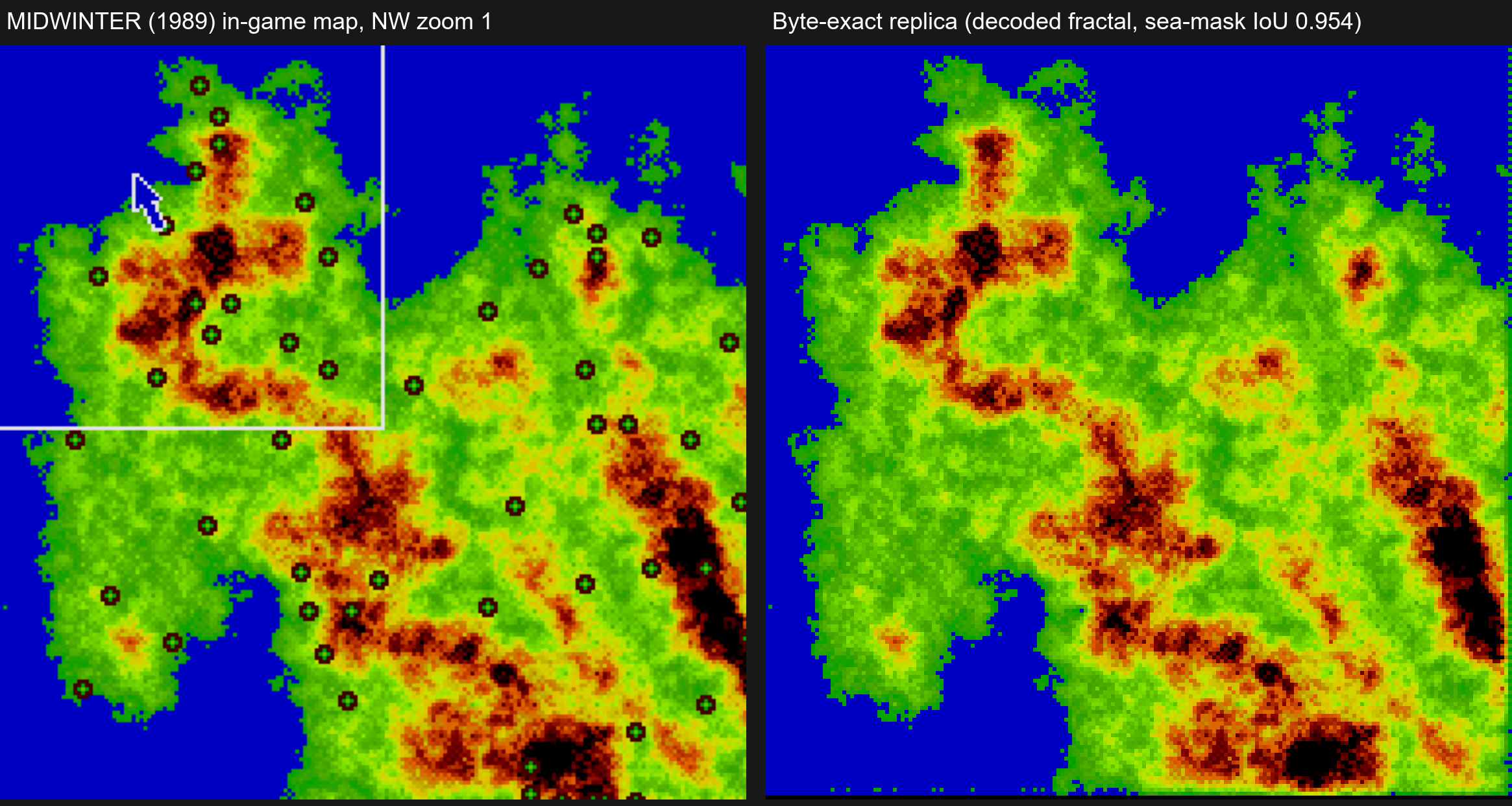
- The terrain is pure math. The whole 160,000-square-mile island grows from a 10KB seed file through a fractal with zero randomness — roughness scales with altitude, so calm seas and craggy peaks come from one rule.
- Every tree is deterministic too — placement is a simple hash of the terrain heights. Replay 1990's Midwinter today and every pine stands exactly where it stood then.
- Vehicle physics formulas — ski acceleration, buggy rollover, glider lift and stall — all small integer equations driven by your character's condition.
- The enemy AI's secrets — units never actually hunt you; only one unit can engage you at a time (it's structural, not luck); killing a commander really does destroy the whole unit.
- The real win/lose conditions — including a hidden way to win by simply surviving 20 days.
- Two myth-busting negative results — the original has no time-of-day system and no companion auto-travel. Knowing what ISN'T there matters as much for a faithful remaster.
WHY IT MATTERS FOR THE REMASTER
Until now, remastering meant playing the original, taking notes, and guessing at the rules underneath. Now the remaster builds against ground truth: when our Unreal Engine 5 version implements skiing, enemy movement, or terrain, it can match the original's actual algorithms — and where we deliberately modernize, we know exactly what we're changing.
THE STORY, IN 100 SECONDS
THE ANALYSIS IS OPEN SOURCE
The complete decode — system documentation, the 602-function ledger with evidence citations, the analysis tools, and the bit-exact Python replicas — is published as a free, MIT-licensed repository. (It contains our analysis of the game, not the game itself — no copyrighted material.)
Honesty note: most of the ledger is verified statically against the binary's disassembly; the strongest results (terrain, trees, map colors) are additionally runtime-verified by bit-exact comparison against the running game. About 20 low-confidence items remain flagged for runtime testing — corrections welcome via GitHub. Midwinter was created by Mike Singleton (1989). This is an unaffiliated fan project for preservation and study.